
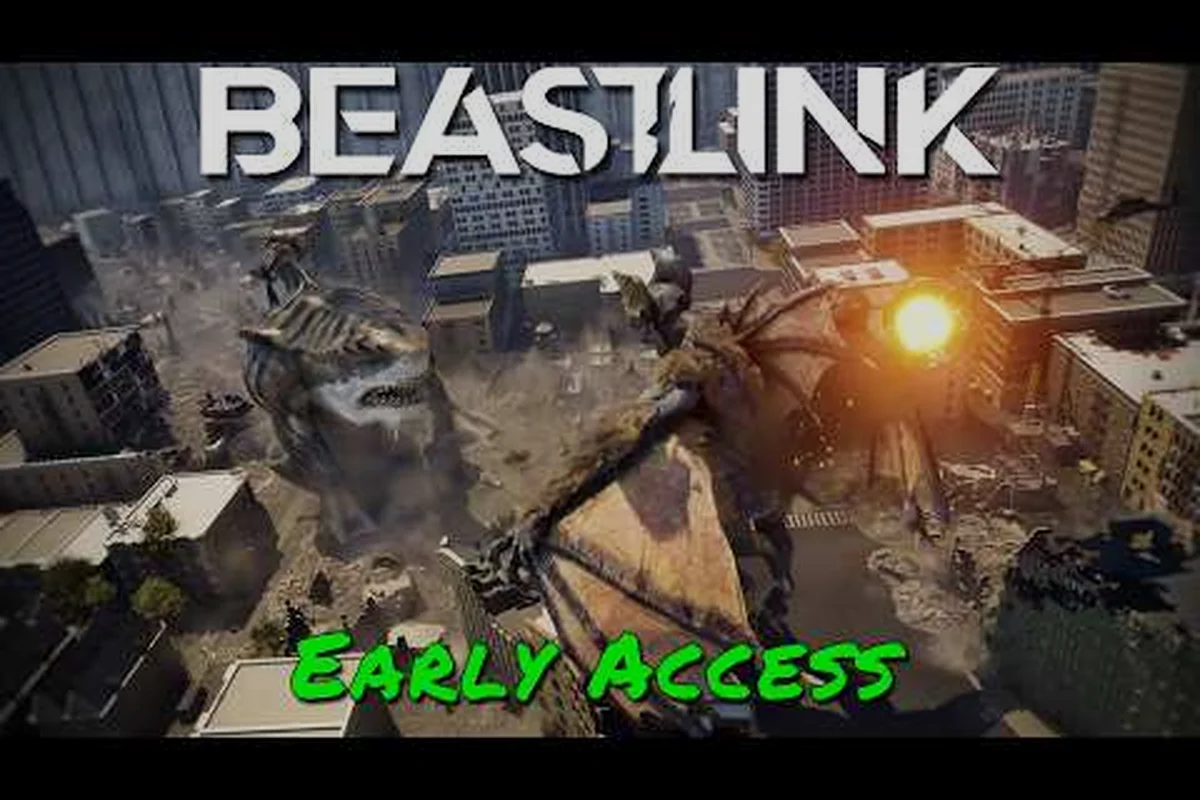
BeastLink hits Early Access on August 18, 2026, and the first hours inside the city will decide how fast you climb the serum economy. This BeastLink early access guide breaks down the three launch maps, the four playable Beasts, the Link system, and the exact steps you should take before your first match so you land with a plan instead of wandering into a collapsing skyline.
Because the game pits up to 32 players against multiple active Kaiju in fully destructible environments, knowing what to do first separates a squad that controls the city from one that gets flattened by a rogue tail swipe. The official Steam page confirms the console versions for Xbox Series X|S and PS5 are coming soon, but PC players get first crack at the chaos. Let's walk through the essentials.
According to BeastLink on Steam, the early access build currently includes 3 playable maps and 4 Beasts with distinct roles, and the developers have confirmed that progression data will reset when the full 1.0 release arrives around Summer 2027. That reset makes Early Access a low-stakes testing ground, so experiment with different roles and loadouts freely while you learn the systems.
BeastLink Early Access Guide: What You Need to Know Before Launch
BeastLink is a giant multiplayer Kaiju experience where humans, vehicles, and colossal Beasts collide in fully destructible cities. The core loop is simple to understand but brutal to master: earn serum, Link with dormant Kaiju, and unleash devastating powers that collapse entire city blocks. The SuperDestruction system means no two fights play out the same because the terrain changes with every building that falls.
Here's the launch snapshot you need before queueing up. It summarizes the confirmed platforms, the 32-player match size, the three launch maps, the four playable Beasts, and the serum economy so you have the full picture before your first drop into the city.
-
Platform: PC via Steam Early Access on August 18, 2026
-
Full release: Planned for around Summer 2027
-
Console: Xbox Series X|S and PS5 versions announced as coming soon
-
Player count: Matches support up to 32 players
-
Maps: 3 distinct city environments at launch
-
Beasts: 4 playable Kaiju with unique ability sets
-
Core resource: Serum, earned through gameplay and spent on Links
The Link system is the heart of BeastLink because it lets you spend serum to connect with dormant Kaiju Beasts, taking control of colossal creatures with unique abilities. Building your Link is the core power fantasy, but it requires careful resource management because serum doesn't flow freely in every match.
If you want the full breakdown of how Links affect your long-term power curve, the BeastLink progression explained guide covers the resource economy in detail. For now, focus on the fundamentals in this BeastLink early access guide, because understanding the Link sequence and serum flow comes before any advanced economy planning. Once those basics feel natural, the progression guide will show you how to accelerate your growth.
The 3 Launch Maps and How to Use Them
Each of the three launch maps offers a different rhythm for both human players and Beasts. Community reports from the closed testing phase suggest that map knowledge matters more than raw aim because the destructible environment creates sightlines that change mid-fight.
Map 1: Harbor District
The Harbor District features wide-open waterfront areas with container stacks that provide natural cover for infantry. The map favors vehicle play because the long sightlines allow armored squads to control choke points. Beasts here need to watch for naval artillery placements that players can activate for massive damage.
Map 2: Downtown Core
Downtown Core is the densest map with skyscrapers that create vertical combat zones. Human players can use rooftops to escape Beasts, but those same buildings become projectiles when a Kaiju tears them loose. This map rewards teams that coordinate building destruction to create new pathways while denying the enemy cover.
Map 3: Industrial Park
The Industrial Park offers a mix of open factory floors and tight interior corridors. This map has the most environmental hazards, including explosive tanks and chemical silos that can turn a Beast fight into a chain reaction disaster. Players report that the Industrial Park is the best map for learning how to escape a Beast because the interior spaces provide multiple escape routes.
| Map | Primary Terrain | Best For | Beast Advantage |
|---|---|---|---|
| Harbor District | Waterfront, containers | Vehicle squads | Long sightlines for ranged attacks |
| Downtown Core | Skyscrapers, vertical | Rooftop tactics | Building projectiles |
| Industrial Park | Factories, corridors | Close-quarters combat | Environmental chain reactions |
The map rotation at launch cycles through all three environments, so you need at least a basic strategy for each. According to community data from the beta, teams that win consistently adapt their loadout to the map rather than forcing one playstyle everywhere.
The 4 Playable Beasts and Their Roles
BeastLink launches with four playable Beasts, each designed for a different combat role. Understanding their strengths helps you decide which Kaiju fits your playstyle and which Links to prioritize as you earn serum. The roster ranges from the balanced Vanguard to the stealth-focused Wraith, so try each one in the tutorial before committing your hard-earned serum to a particular creature.
Beast 1: Vanguard
Vanguard is the balanced starter Beast with solid damage and durability across all ranges. Its abilities focus on straightforward brawling, making it the best choice for players who want to learn the Beast controls without complex mechanics. Vanguard's rage ability increases attack speed, which pairs well with building destruction to create panic among human players.
Beast 2: Tempest
Tempest trades durability for speed and aerial options. This Beast can leap across city blocks and unleash lightning-based area attacks that punish clustered infantry. Tempest requires more positioning awareness because its lower health pool means you need to avoid sustained fire from vehicle squads.
Beast 3: Colossus
Colossus is the tank of the roster with massive health and devastating melee swings. Its slow movement speed makes it vulnerable to hit-and-run tactics, but when it connects, the damage is catastrophic. Colossus shines in tight maps like the Industrial Park where players cannot easily maintain distance.
Beast 4: Wraith
Wraith is the stealth-oriented Beast that can phase through structures and ambush unsuspecting squads. Its complex ability kit has a steeper learning curve, but community reports indicate that a skilled Wraith player can single-handedly dismantle a coordinated team by targeting their vehicle support first.
| Beast | Role | Health | Difficulty | Best Map |
|---|---|---|---|---|
| Vanguard | Balanced brawler | High | Beginner | All maps |
| Tempest | Mobile attacker | Medium | Intermediate | Harbor District |
| Colossus | Heavy tank | Very High | Beginner | Industrial Park |
| Wraith | Stealth ambusher | Low | Advanced | Downtown Core |
Your first few matches should focus on Vanguard while you learn the fundamentals, then branch out once you understand how the Link system affects your available Beasts. The BeastLink link system guide explains how to unlock additional Beasts through progression, which ties directly into your early access strategy.
BeastLink How to Link with Beasts: The Link System Explained
The Link system is the defining mechanic of BeastLink, and this BeastLink early access guide would be incomplete without a full breakdown. When you earn enough serum, you can spend it to connect with a dormant Kaiju Beast and take direct control of that creature.
Here's the step-by-step process for linking, which the official Steam page describes as the core power fantasy of BeastLink. Follow these steps in order and you will go from ground-level soldier to colossal Kaiju in under a minute, provided you have banked the required serum for the Beast you want.
-
Earn serum by completing objectives, damaging structures, or defeating enemy players.
-
Locate a dormant Beast on the map—they appear as glowing markers with a pulsing radius.
-
Approach the Beast and hold the interaction button to begin the Link sequence.
-
Spend the required serum to complete the Link and take control.
-
Use the Beast's abilities until your Link expires or you choose to disconnect.
The serum cost varies by Beast, with Vanguard being the cheapest and Wraith requiring the most investment. This creates an interesting economy decision because spending too much serum early leaves you vulnerable as a human player, and a wasted Link means your squad fights the next objective without its strongest asset. New players should bank their first few Links for Vanguard to learn the mechanics before experimenting with expensive roster options.
Link Duration and Cooldowns
Once you Link with a Beast, the connection lasts for a limited duration before the Kaiju returns to dormancy. Community testing suggests that the cooldown period between Links is significant, so you cannot simply chain Beast forms back-to-back. This forces teams to decide who gets the Link at critical moments rather than everyone hoarding serum.
| Beast | Serum Cost | Link Duration | Cooldown |
|---|---|---|---|
| Vanguard | Low | Medium | Short |
| Tempest | Medium | Medium | Medium |
| Colossus | High | Long | Long |
| Wraith | Very High | Short | Very Long |
The Link system rewards strategic resource management because a well-timed Beast transformation can flip a losing fight, while a wasted Link leaves your team without its strongest asset. For a deeper dive into Link mechanics and advanced strategies, check out our BeastLink early access progression guide that covers the full progression path.
BeastLink How to Get Serum: Farming Strategies That Work
Serum is the lifeblood of BeastLink, and knowing how to get serum efficiently determines whether you spend most matches as a human or as a Beast. The game rewards active participation rather than passive camping, so the best serum rates come from staying busy.
Here are the most reliable serum sources based on community reports from the beta. The list is ordered roughly by consistency, with the activities that deliver steady income across every map ranked ahead of high-variance plays that only pay off under ideal conditions.
-
Objective completion: Capturing and holding objectives grants a steady serum trickle over time.
-
Structure destruction: Damaging buildings and environmental objects contributes to your serum income, which makes the SuperDestruction system economically important.
-
Player eliminations: Taking down enemy players awards a serum bounty that scales with their current score.
-
Assist bonuses: Supporting teammates through healing, suppression, or vehicle repair generates smaller but consistent serum gains.
-
Survival streaks: Staying alive for extended periods without dying grants bonus serum at interval milestones.
The Serum Economy in Early Access
The serum economy in Early Access may differ from the full release because the developer is likely tuning values based on player feedback. According to community data, the fastest serum rates come from teams that split their focus between objective play and structure destruction rather than chasing eliminations exclusively.
| Activity | Serum Rate | Risk Level | Consistency |
|---|---|---|---|
| Objective capture | Medium | Medium | High |
| Structure destruction | Medium | Low | Very High |
| Player eliminations | High | Very High | Low |
| Assists | Low | Low | High |
| Survival streaks | Medium | Medium | Medium |
The best approach in the early access period is to mix objective play with structure destruction while avoiding unnecessary fights that put your survival streak at risk. This balanced strategy keeps serum flowing without exposing you to the high-risk, high-reward elimination playstyle.
If you want to accelerate your serum income even further, the BeastLink how to level up fast guide covers advanced farming rotations and role-specific strategies that maximize your earnings per match. That guide goes deeper into the five-minute priority chain and the role-by-role breakdown, so you can turn the steady income this guide establishes into genuinely fast progression.
BeastLink Controls Guide: Keybinds, Movement, and Combat
A solid BeastLink controls guide is essential because the game features two distinct control schemes: one for human characters and another for Beasts. The official website confirms that players switch between these modes through the Link system, so you need to be comfortable with both.
Human Character Controls
Human characters play like a third-person shooter with parkour elements, allowing you to climb buildings and vault over obstacles while fighting. The standard keybinds follow familiar conventions for the genre, but you should customize them before your first match, because the ability to sprint, vault, and interact with the Link system smoothly is the difference between escaping a collapsing building and being buried under it.
| Action | Default Key | Notes |
|---|---|---|
| Move | WASD | Standard movement |
| Sprint | Shift | Consumes stamina |
| Jump/Vault | Space | Context-sensitive |
| Interact/Link | E | Hold for Link sequence |
| Primary weapon | Left Mouse | Fires equipped weapon |
| Ability | Q | Class-specific ability |
| Reload | R | Manual reload |
| Ping | Middle Mouse | Team communication |
Beast Controls
Beast controls are deliberately slower and more deliberate, emphasizing positioning over twitch reactions. Each Beast has a unique move set, but the core controls remain consistent across the roster, so once you learn to pilot one Kaiju, switching to another only requires learning its abilities rather than relearning the entire control scheme. This consistency makes the Beast experience far easier to master than it first appears.
| Action | Default Key | Notes |
|---|---|---|
| Move | WASD | Slower than human movement |
| Light attack | Left Mouse | Fast, low damage |
| Heavy attack | Right Mouse | Slow, high damage |
| Ability 1 | Q | Beast-specific power |
| Ability 2 | E | Beast-specific power |
| Rage/Ultimate | R | Requires full rage meter |
| Roar | F | Intimidation, brief slow effect |
The controls guide section of this BeastLink early access guide would be incomplete without mentioning that the game supports both mouse and keyboard and gamepad. According to player reports, gamepad controls feel more natural for Beast movement, while mouse and keyboard offer better precision for human combat.
For vehicle-specific controls and squad coordination, the BeastLink vehicle squad guide covers loadouts and strategies for armored play. That guide explains the different vehicle classes, their movement profiles, and how to coordinate with infantry and Beasts, giving you everything you need to contribute from the driver's seat as well as on foot.
BeastLink What to Do First: Your Opening Match Checklist
New players often ask what to do first in BeastLink, and the answer depends on whether you queue solo or with a squad. Your first match should focus on learning rather than winning because the destruction mechanics create chaotic situations that take time to read.
Here's the opening checklist for your first match, ordered so that you handle settings and fundamentals before you ever enter the queue. Working through these steps in advance means your first live game is about learning the chaos of combat rather than fumbling with menus.
-
Customize your controls in the settings menu before queueing to avoid confusion mid-fight.
-
Complete the tutorial to learn both human and Beast controls, including the Link sequence.
-
Play Vanguard for your first few Beast forms because the balanced kit teaches fundamentals.
-
Stick with your squad and prioritize objective play over eliminations to build serum steadily.
-
Observe the map and identify safe escape routes before engaging the enemy Beast.
-
Spend serum wisely on your first Link rather than saving it for a more expensive Beast you cannot afford yet.
-
Learn from destruction by watching how buildings collapse and which environmental hazards are worth exploiting.
The first hour of BeastLink is about building muscle memory for both control schemes. Once you understand the rhythm of switching between human and Beast forms, the game opens up into a deep tactical experience where positioning, resource timing, and squad coordination matter more than raw aim. Do not be discouraged by early wipes—every match teaches you something about the destructible environments that you will use for the rest of your time in the game.
Solo vs. Squad Play in Early Access
Solo queueing in BeastLink is viable, but the game clearly favors coordinated squads because the Link system creates natural team synergy. If you play solo, focus on supporting your random teammates by pinging objectives and sharing serum data, and let them take the flashy Beast roles while you anchor the objective play. A flexible solo player who fills gaps in a squad's composition is far more valuable than a rigid one who insists on a single role.
| Playstyle | Pros | Cons | Best For |
|---|---|---|---|
| Solo queue | Flexible, no coordination needed | Unpredictable teamwork | Learning fundamentals |
| Small squad (2-3) | Balanced coordination | Limited map coverage | Objective play |
| Full squad (4+) | Maximum coordination | Requires communication | Competitive play |
The early access period is the perfect time to experiment with different squad sizes because the player base is still learning the game together. Community reports suggest that small squads of two or three players see the most consistent success because they can coordinate Links without the communication overhead of a full squad.
Frequently Asked Questions
What is the best Beast for beginners in BeastLink?
Vanguard is the best starting Beast because its balanced stats let you learn the Link system without punishing mistakes. The lower serum cost also means you can practice the Link sequence more often in a single match. Once you understand the basics, try Colossus for a tankier experience.
How long does a BeastLink match last?
A standard BeastLink match runs 12 minutes, but early access tweaks can stretch it to 15 if both teams stall on objectives. You’ll see a countdown timer top-center; sudden-death overtime kicks in at 0 if the core’s still standing. Plan your build around that window.
Can I play BeastLink on console at launch?
No, BeastLink launches on PC via Steam Early Access on August 18, 2026. The official Steam page confirms that Xbox Series X|S and PS5 versions are coming soon, but the developer has not announced a specific release date for consoles yet.
Is the serum economy in BeastLink pay-to-win?
No, serum in BeastLink Early Access is strictly gameplay-earned—no real-money purchases exist for it or Beast unlocks. The developer’s roadmap confirms zero microtransactions during Early Access, so progression hinges on skill and playtime, not wallet size, keeping every player’s field level.
When does BeastLink leave Early Access?
BeastLink leaves Early Access around Summer 2027, per its Steam page, after roughly a year of updates. That window lets you master the Link system before the 1.0 meta shifts. Use this time to test serum combos—your early feedback could shape the final balance.